

South America Is Becoming a Global Center for Ag Innovation

South America is entering 2026 with growing influence across global agriculture, driven by trade expansion, sustainability demands, and rising investment in agricultural technology.
Brazil alone recorded $169.2 billion in agricultural exports in 2025, up 3% year over year, reinforcing the region’s role in global food production. At the same time, the long-awaited EU–Mercosur trade agreement is expected to create a free trade zone of more than 700 million people, representing nearly 20% of global GDP.
Together, these developments are accelerating demand for traceability, sustainable production systems, and supply chain transparency across Latin America, particularly as European regulations place greater pressure on deforestation-free sourcing and climate compliance.
Traceability and Sustainability Drive Investment
As tariffs shift and geopolitical uncertainty continues to reshape global trade, South American agriculture is increasingly positioning itself around resilience, productivity, and sustainability.
Regulations such as the EU Deforestation Regulation (EUDR) are pushing agribusinesses to invest more heavily in traceability infrastructure and sustainable production practices. The region already has structural advantages in these areas, including integrated supply chains, multiple annual harvest cycles, and large-scale agricultural production capacity.
Rather than operating solely as a commodity exporter, South America is becoming a strategic player in climate-aligned food production and agricultural innovation.
Biologicals, AI, and Regenerative Agriculture Gain Momentum
Investment across the region continues to grow in areas such as biological inputs, regenerative agriculture, robotics, and AI-driven farm technologies.
Brazil remains one of the strongest innovation hubs in the region, attracting $77.7 billion in foreign direct investment in 2025 alongside major national initiatives such as the New Industry Brazil (NIB) program and the Brazil Climate Investment Platform (BIP).
Biological crop inputs continue to stand out as one of the country’s fastest-growing segments. Brazil’s biologicals market reached $914 million in 2025 and is expected to continue expanding through 2034, fueled largely by adoption across soybean and corn production.
Research institutions such as Embrapa are also playing a central role in advancing low-carbon agriculture, digital farming, and regenerative production systems.
World Agri-Tech Returns to São Paulo
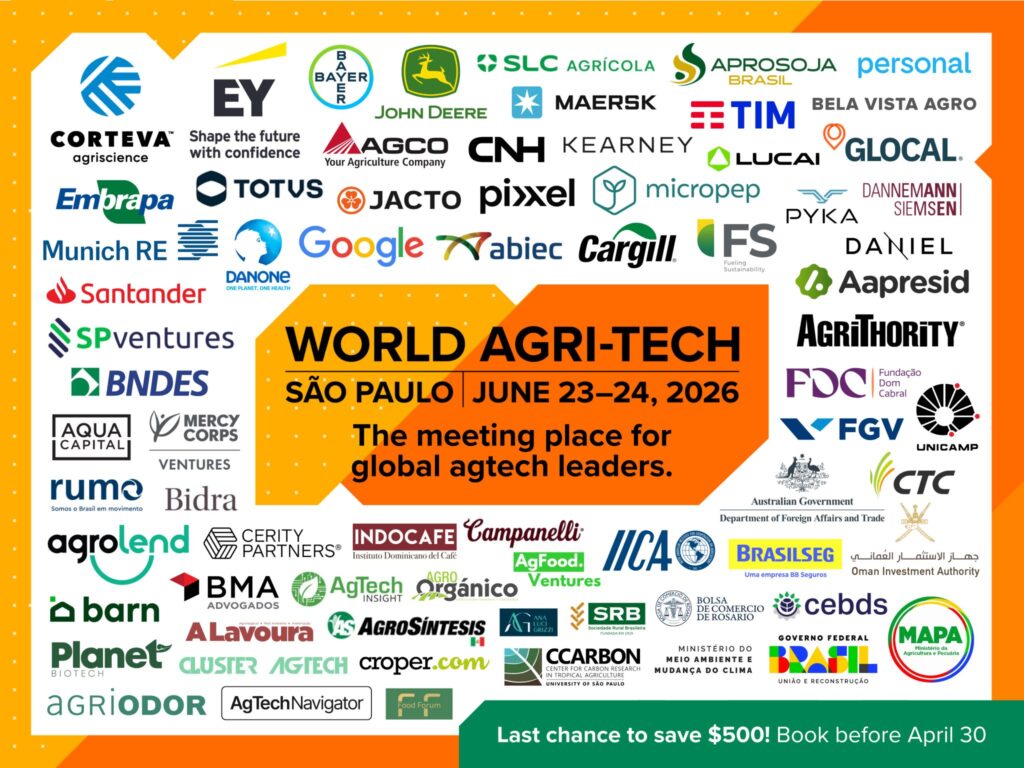
Against this backdrop, the World Agri-Tech South America Summit will return to São Paulo on June 23–24, bringing together more than 600 leaders from across the agrifood value chain.

Now in its seventh edition, the event has become one of the region’s main meeting points for agribusinesses, startups, investors, food companies, technology providers, and policymakers focused on agricultural innovation in Latin America.
This year’s agenda includes topics such as:
- Biologicals and regenerative agriculture
- AI and robotics adoption
- Traceability and compliance
- Livestock emissions reduction
- Investment trends shaping the Latin American agtech ecosystem
The program will also feature speakers including Silvia Massruhá, along with executives, founders, and investors from across the industry.
As climate pressures, supply chain complexity, and food demand continue to reshape global agriculture, South America is increasingly positioning itself as one of the most important regions driving the next phase of agricultural innovation.
Early Bird registration for World Agri-Tech South America Summit is available until May 28, 2026.
Respuestas